
Local travel guide
Cenotes with Kids: Safety, Best Types, Life Jackets and Family Planning
Choose a family cenote by access, supervision, water entry, facilities, transportation and the child’s comfort with deep or enclosed water.
Start with the least flexible person in the family
This is the easiest way to choose.
Maybe you have a toddler who needs constant hands-on supervision. Maybe one child does not swim. Maybe a grandparent needs handrails. Maybe somebody dislikes caves.
Plan around that person first. Everyone else can usually adapt.
Before choosing a cenote, check:
- stairs and handrails
- how you actually enter and exit the water
- child-size life jackets
- a dry viewing or waiting area
- bathrooms and changing rooms
- shade and places to sit
- distance from parking to the water
- minimum ages for jumps, ziplines or other activities
Individual venue rules change, so confirm anything essential directly before going.
A cenote is not a swimming pool
Even a well-run cenote is a natural environment. Water can be deep and cool. Limestone steps can be wet. Cave areas can be dark and echo. Rural properties may have insects, uneven paths and weak mobile service.
Tell children what the place will actually be like before you arrive. A nervous child usually does better when the first sight of dark water is not a surprise.
Which cenote type is best for kids?
There is no single best type.
Open cenotes
These often feel less intimidating because there is daylight and open sky. That can help a cautious child.
But open cenotes can still have very deep water, slippery edges or high jumping platforms.
Semi-open cenotes
These can give children some of the cave experience without feeling completely enclosed. Access varies enormously, so photographs alone are not enough.
Cave cenotes
They can be beautiful, but darkness, stairs, echoes and deep water may be too much for some younger or nervous children.
Do not force the experience because everyone else wants the cave photo.
Our Cenote Types Guide explains the differences.
Babies and toddlers
With very young children, the difficult part is often not swimming. It is managing heat, naps, feeding, bags and constant supervision near water.
A short walk, shade, an easy changing area and flexible transportation matter a lot.
A toddler does not need to enter the water for the outing to count. One parent can swim while another stays dry, or everyone can enjoy the setting and leave when the child has had enough.
Preschool and younger school-age kids
Show them a realistic photo first. Explain that the water may be cold and deep, show them the life jacket and point out where they can get back out.
Let a hesitant child sit on a step or watch before deciding whether to enter.
Do not throw, push or lower a resisting child into the water. A vacation activity is not worth turning water into something they fear.
Older kids and teenagers
Older children may be more comfortable in the water but more willing to copy risky behavior.
Set the rules before everyone gets excited: no unofficial jumps, no climbing limestone for photographs, no following divers into restricted areas and no disappearing into dark passages.
If the property has ropes, ziplines or jumping platforms, check the current rules rather than assuming that being tall enough means the activity is appropriate.
Life jackets and supervision
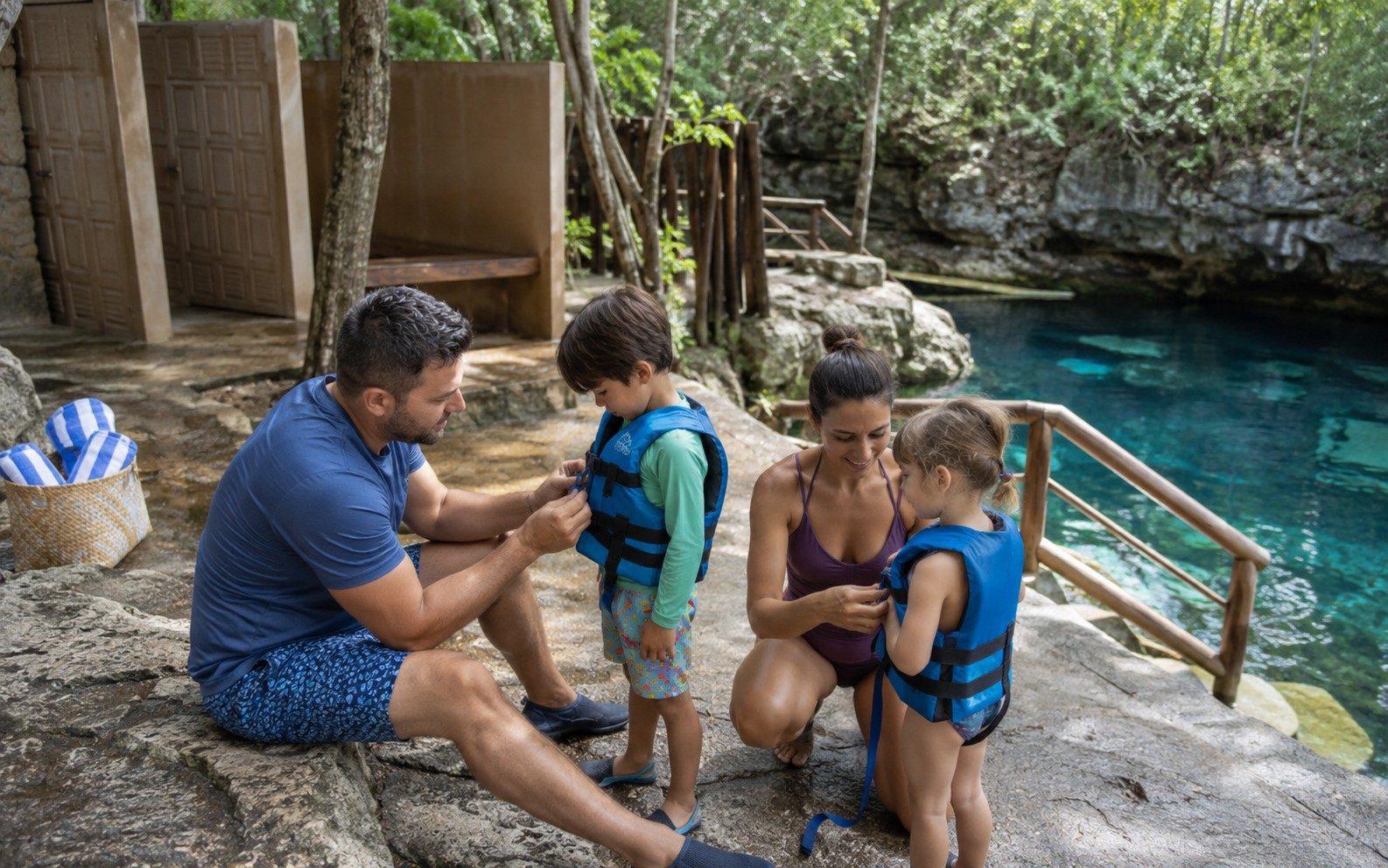
Use required flotation and check the fit. A jacket should be secured properly and should not ride up over the child’s face.
More important: a life jacket does not replace an adult.
Before anyone enters, decide which adult is responsible for which child. The person supervising a young swimmer should not simultaneously be the family photographer.
One cenote is usually enough
Families often build itineraries as if cenotes are five-minute roadside stops. They are not.
There is driving, parking, admission, bathrooms, changing, lockers, showers, life jackets, swimming, getting everyone dry again and finding food afterward.
For many families, one good cenote visit is much better than rushing through two or three.
If you are staying around Cancun, start with our Best Cenotes Near Cancun Guide. For Puerto Morelos, see the Ruta de los Cenotes Guide. If you are heading toward Valladolid, compare Cenotes Near Valladolid.
Combining a cenote with another destination
A cenote can pair well with Valladolid, Puerto Morelos or Chichen Itza, but protect the main reason for the day.
If Chichen Itza is the priority, I would rather visit the ruins while the family still has energy and swim afterward than arrive at the archaeological site late with tired children.
The same principle applies everywhere: do the less flexible activity first and keep the cenote adjustable when possible.
Transportation with children
Private transportation or a rental car gives families the easiest early-exit option and more control over dry clothes, snacks, naps and child seats.
A group tour removes the driving, but ask how long the entire day lasts and whether you can leave early if a child is finished.
If you need a child seat, confirm the exact arrangement before travel. Do not assume one will automatically be available.
What I would bring
- swimwear already on when practical
- dry clothes for each child in a separate bag
- water
- a familiar snack for afterward
- water-friendly footwear with grip
- any essential medication
- a small towel if the venue or tour does not provide one
Follow the cenote’s current rules about sunscreen and other products before entering the water.
Frequently asked questions
What age is good for visiting a cenote?
There is no universal age. It depends on the specific cenote’s rules and access, the child’s comfort around water and whether the adults can provide appropriate supervision.
Are open cenotes better for children?
They can feel less intimidating because they are brighter, but they may still be very deep. Judge the actual water entry, facilities and supervision rather than the category alone.
Can a child who cannot swim visit a cenote?
Often, yes, but whether the child should enter the water depends on venue rules, properly fitting flotation, direct adult supervision and the child’s comfort. Watching safely from outside the water is also completely fine.
Are cenotes cold?
The water can feel noticeably cooler than the Caribbean or a hotel pool. For younger children, a shorter first swim may be more enjoyable.
Accidental Gringo tip
Choose for the least confident swimmer. A cenote that everyone can enjoy comfortably is better than a spectacular one that half the family wants to leave.
Before you go: Confirm the cenote's current family rules, prices, access conditions, minimum ages, life-jacket requirements and activity restrictions directly with the venue.